
Fence · Hedge · Construction
Property staking: know exactly where your lines are
In short
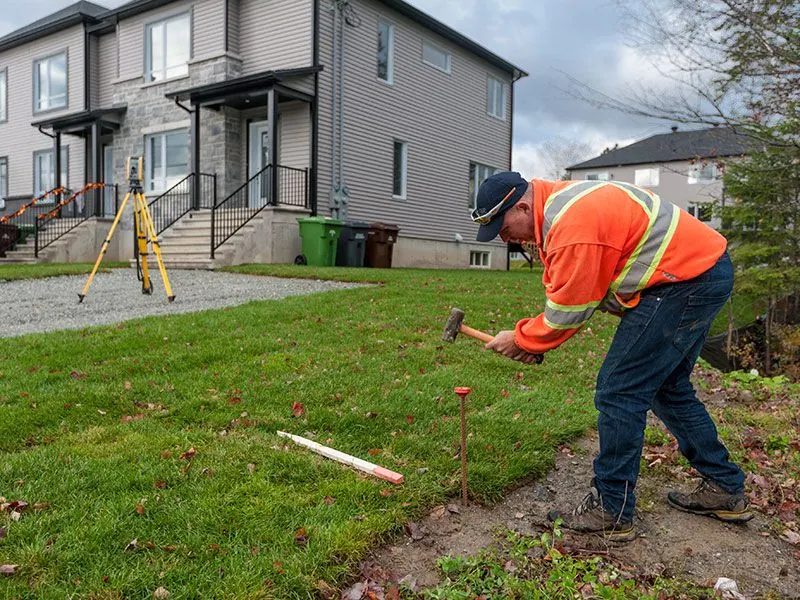
Staking (piquetage) is when a land surveyor finds your lot lines from your titles and the cadastre, then marks them with visible markers. You do it before putting up a fence, planting a hedge, building near the line or cutting trees. In Quebec, only a land surveyor (arpenteur-géomètre) can stake a property.
When do you need it?
- You're putting up a fence or planting a hedge
- You're building a garage, shed or pool near the line
- You're buying vacant land and want to see what you're getting
- You plan to cut trees or landscape near the edge of a wooded lot
- The old markers are gone or you're not sure where they are
What the mandate includes
- Review of titles, cadastre and earlier survey plans
- Search for existing markers on the ground
- Measurements and calculation of the lines
- New markers at the corners and points needed
- A signed document describing the work and the markers set
- A walk-through on site if you are there
What markers are set?
At the corners, we usually drive an iron rod, often with a cap. It stays in place for years if nobody disturbs it. To make it easy to see during work, we add a wooden stake with coloured flagging tape. The stake is temporary.
A tip: show the markers to your contractor or fence installer before they start. If a marker is pulled out or moved, the staking has to be redone to find the line again.
Staking or boundary determination?
Staking shows where the line is according to your titles. It doesn't bind your neighbour and doesn't settle a dispute. If you and your neighbour disagree on the line, you need a boundary determination (bornage): a procedure under the Civil Code that fixes the line for good. Our guide Staking vs boundary determination compares the two.
Staking wooded or mountain lots
In the Pays-d'en-Haut and around Mont-Tremblant, many lots are several thousand square metres, wooded and sloped. Lines can run for hundreds of metres through the forest, and the oldest markers sometimes date back to the original township surveys. We may have to clear a line of sight through the brush, which takes longer than a suburban job.
In winter, snow and frozen ground make it harder to find old markers and drive new ones. If your project starts in spring, call us in late winter to book your spot.
Timelines and cost
The price depends on how many points to stake, the length of the lines, vegetation, terrain and research needed. Staking one side of a suburban lot is quick. Staking the full perimeter of a wooded multi-hectare lot is a different project. Tell us which lines you need and you'll get a written price and timeline.
Useful documents to send us
- The address or lot number
- Your deed of purchase
- Your certificate of location or any older plan
- Which lines you need staked (all or one side)
- The date your work starts
None of this is required to get a quote. The address is enough to get started.
Steps
How it works
-
Your request
Tell us which lines you need and when your work starts. We send a written price and timeline.
-
Research
We review your titles, the cadastre and existing plans to reconstruct the lines.
-
On site
We find existing markers, measure, then set new markers where needed.
-
Signed document
You receive a document describing the markers set. We can show them to you on site.
Fence or hedge coming up? Get staked before you dig.
Service areas
Property staking from Laval to Mont-Tremblant
Our office is in Val-David. Pick your town to see what makes it different.
Detailed pages for this service
FAQ
Frequently asked questions: staking
Does staking settle a disagreement with my neighbour?
No. It shows the line according to your titles but doesn't bind your neighbour. For a final answer, you need a boundary determination.
Can I remove or move a survey marker?
No. Moving or pulling out a survey marker isn't allowed, and the staking would have to be redone. If a marker is in the way during work, call us before touching it.
Is staking required to build a fence?
Not always by the municipality, but it's the only way to be sure you're building on your own land. A fence in the wrong spot may have to be moved at your expense.
Can you stake in winter?
Often, yes. Snow and frozen ground make it slower, especially in the woods. If your work starts in spring, book in late winter.
Related services
Depending on your project
Boundary determination (bornage)
When the line is disputed and needs to be fixed for good.
Certificate of location
For a sale or refinancing.
Building layout and implantation plan
For a new house, garage or addition.
Helpful guides
-
Guide
Staking vs boundary determination in Quebec
Two services that are often confused. Which one you need when the line with your neighbour is in question.
No-obligation quote
Request your quote: property staking
Send us the property address and your deadline. We'll call to confirm the details, then send you a written price and timeline.
- 418 265-9419
- info@arpenteurlaurentides.com
- 1534, rue Vinet, Val-David, QC J0T 2N0
- Monday to Friday, 8 a.m. to 5 p.m.